


My parents were thoughtful enough to keep all my old school books, particularly those from my early years and I now have two large boxes in my office here in Seville. One of my books from First School is full of poems. They are on typed sheets of paper glued into an exercise book. Some of you will remember the duplicating system where the original is typed and the copied version is in purple ink.
Anyway – I can remember some of the poems – not completely but almost. One of my favourites was ‘Cargoes’ (what we didn’t learn was the author of each poem – John Masefield as you ask).
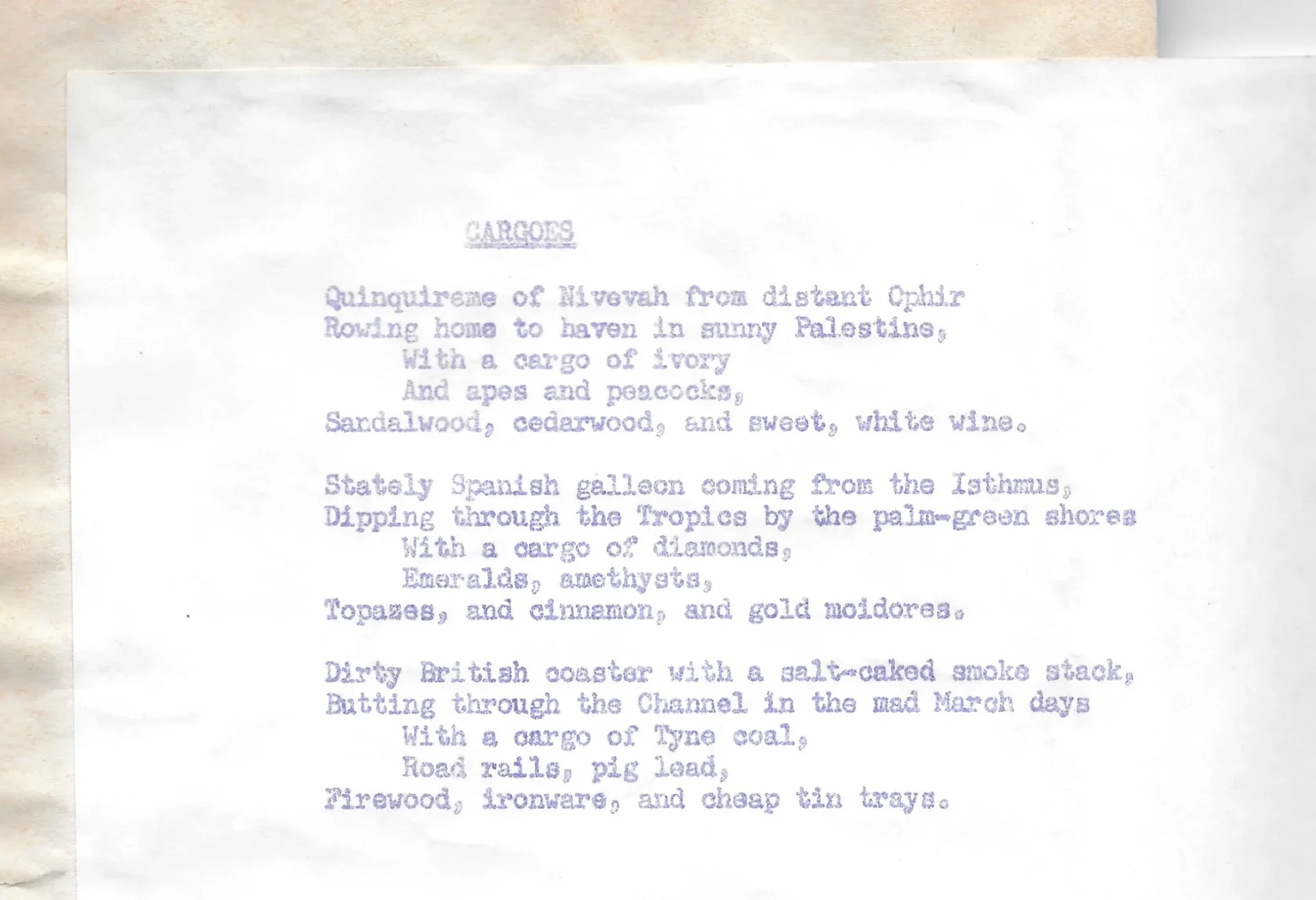
Cargoes
Quinquireme of Nineveh from distant Ophir,
Rowing home to haven in sunny Palestine,
With a cargo of ivory,
And apes and peacocks,
Sandalwood, cedarwood, and sweet white wine.
Stately Spanish galleon coming from the Isthmus,
Dipping through the Tropics by the palm-green shores,
With a cargo of diamonds,
Emeralds, amythysts,
Topazes, and cinnamon, and gold moidores.
Dirty British coaster with a salt-caked smoke stack,
Butting through the Channel in the mad March days,
With a cargo of Tyne coal,
Road-rails, pig-lead,
Firewood, iron-ware, and cheap tin trays.
John Masefield
By the way a Quinquireme is an ancient Roman galley with 5 banks of oars and Moidores are a former Portuguese or Brazilian gold coin that was also current in England in the early 18th century.
I’d like to retrospectively thank Mrs Williams, who had a great enthusiasm and passion for poetry. We had to practice and practice each poem and then perform it at the end of term. It was a great way to learn new words, history, the pace of poetry and rhythms of different combinations. My favourite verse was the last one. Obviously, there were local connections, but it also has a strong rhythm and momentum. By the time we reached the last three words we were shouting.
This capacity for poetry to touch us is something I’ve reconnected with since working with ACT in the Workplace.
I first used a poem in workplace training in 2015 with a group of teachers in Bristol. The response was so powerful that it’s now a regular feature of my training, and my love of poetry has been rekindled. Poetry can help us appreciate the world in a different way and reveal new perspectives.
I’ll finish with two poems that regularly feature in my workshops. I’d love to hear about your favourite poems and why they resonate with you.
START CLOSE IN by David Whyte
Start close in,
don’t take
the second step
or the third,
start with the first
thing
close in,
the step
you don’t want to take.
Start with
the ground
you know,
the pale ground
beneath your feet,
your own
way to begin
the conversation.
Start with your own
question,
give up on other
people’s questions,
don’t let them
smother something
simple.
To hear
another’s voice,
follow
your own voice,
wait until
that voice
becomes an
intimate
private ear
that can
really listen
to another.
Start right now
take a small step
you can call your own
don’t follow
someone else’s
heroics, be humble
and focused,
start close in,
don’t mistake
that other
for your own.
Start close in,
don’t take
the second step
or the third,
start with the first
thing
close in,
the step
you don’t want to take.
in ‘David Whyte : Essentials’ Many Rivers Press © David Whyte
For me, this poem speaks to a fundamental challenge of the human condition, getting started. Whether it’s a planned trip to the gym, a new project or a work resolution, when our mind starts to generate unhelpful ‘stuff’ it can lead to anxiety, despondency or procrastination. I love the pace of this poem and the repetition.
The second poem is called Aimless Love by Billy Collins.
This morning as I walked along the
lakeshore,
I fell in love with a wren
and later in the day with a mouse
the cat had dropped under the dining
room table.
In the shadows of an autumn evening,
I fell for a seamstress
still at her machine in the tailor’s
window,
and later for a bowl of broth,
steam rising like smoke from a naval
battle.
This is the best kind of love, I thought,
without recompense, without gifts,
or unkind words, without suspicion,
or silence on the telephone.
The love of the chestnut,
the jazz cap and one hand on the wheel.
No lust, no slam of the door —
the love of the miniature orange tree,
the clean white shirt, the hot evening shower,
the highway that cuts across Florida.
No waiting, no huffiness, or rancor —
just a twinge every now and then
for the wren who had built her nest
on a low branch overhanging the water
and for the dead mouse,
still dressed in its light brown suit.
But my heart is always propped up
in a field on its tripod,
ready for the next arrow.
After I carried the mouse by the tail
to a pile of leaves in the woods,
I found myself standing at the bathroom
sink
gazing down affectionately at the soap,
so patient and soluble,
so at home in its pale green soap dish.
I could feel myself falling again
as I felt its turning in my wet hands
and caught the scent of lavender and
stone.
This poem touches me deeply. It captures the skill of noticing so effectively. All those moments in a day that we might miss because we’re tangled up inside our own heads.