

A more human approach to leadership
Over the last few years, I’ve noticed something consistent in leadership conversations.
Most leaders already know what effective leadership looks like.
The challenge is what happens in the moments when pressure rises:
- when emotions flare,
- when uncertainty increases,
- when difficult conversations arise,
- when self-doubt gets loud,
- or when exhaustion starts narrowing perspective.
In those moments, leadership becomes less about knowledge and more about psychological flexibility. Under pressure, many leaders don’t lose capability — they lose access to it.
That’s what led me to develop the McIntosh ACT Leadership Framework — a practical model built from Acceptance and Commitment Therapy (ACT), leadership psychology, and real-world coaching conversations.
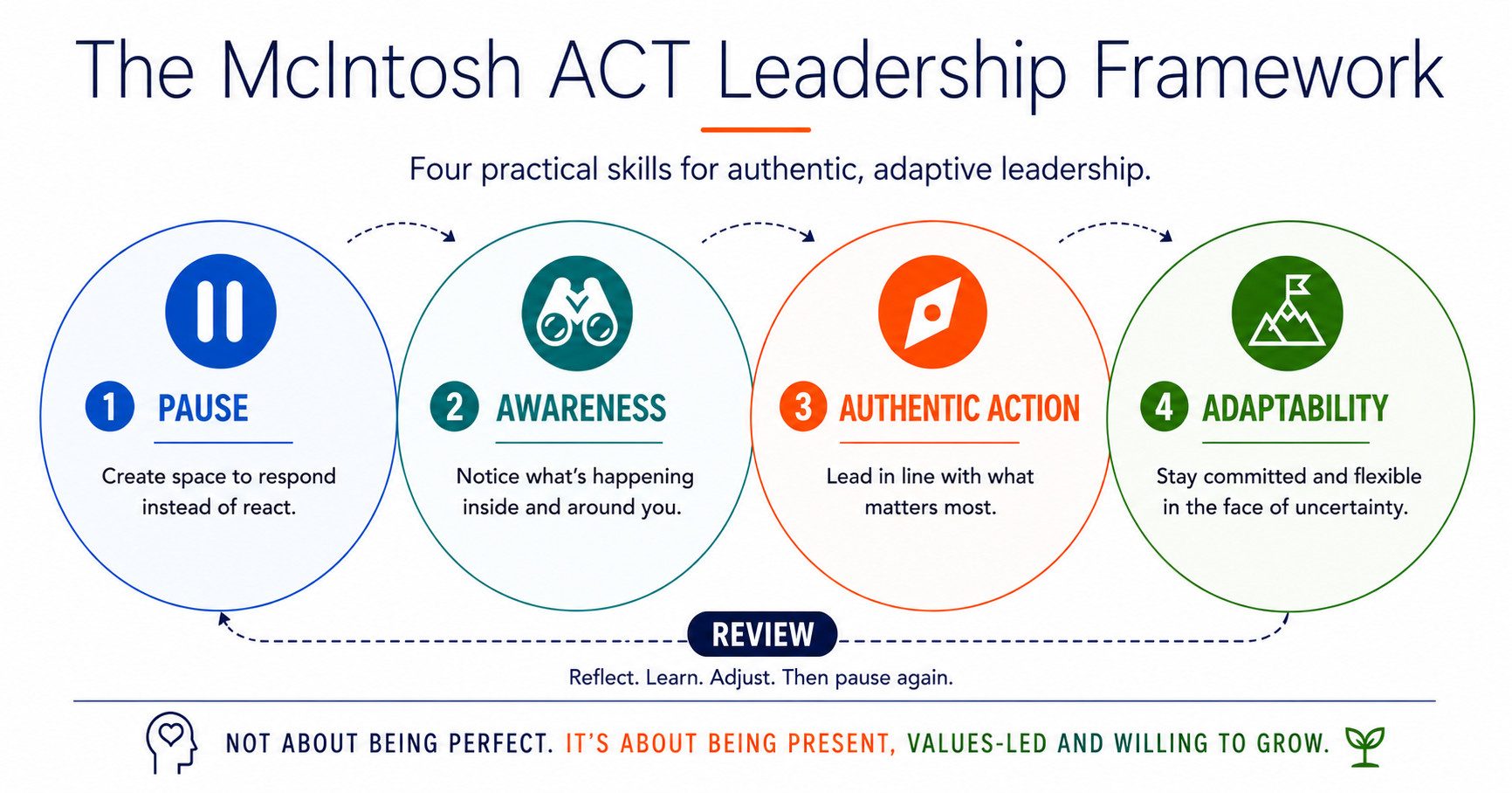
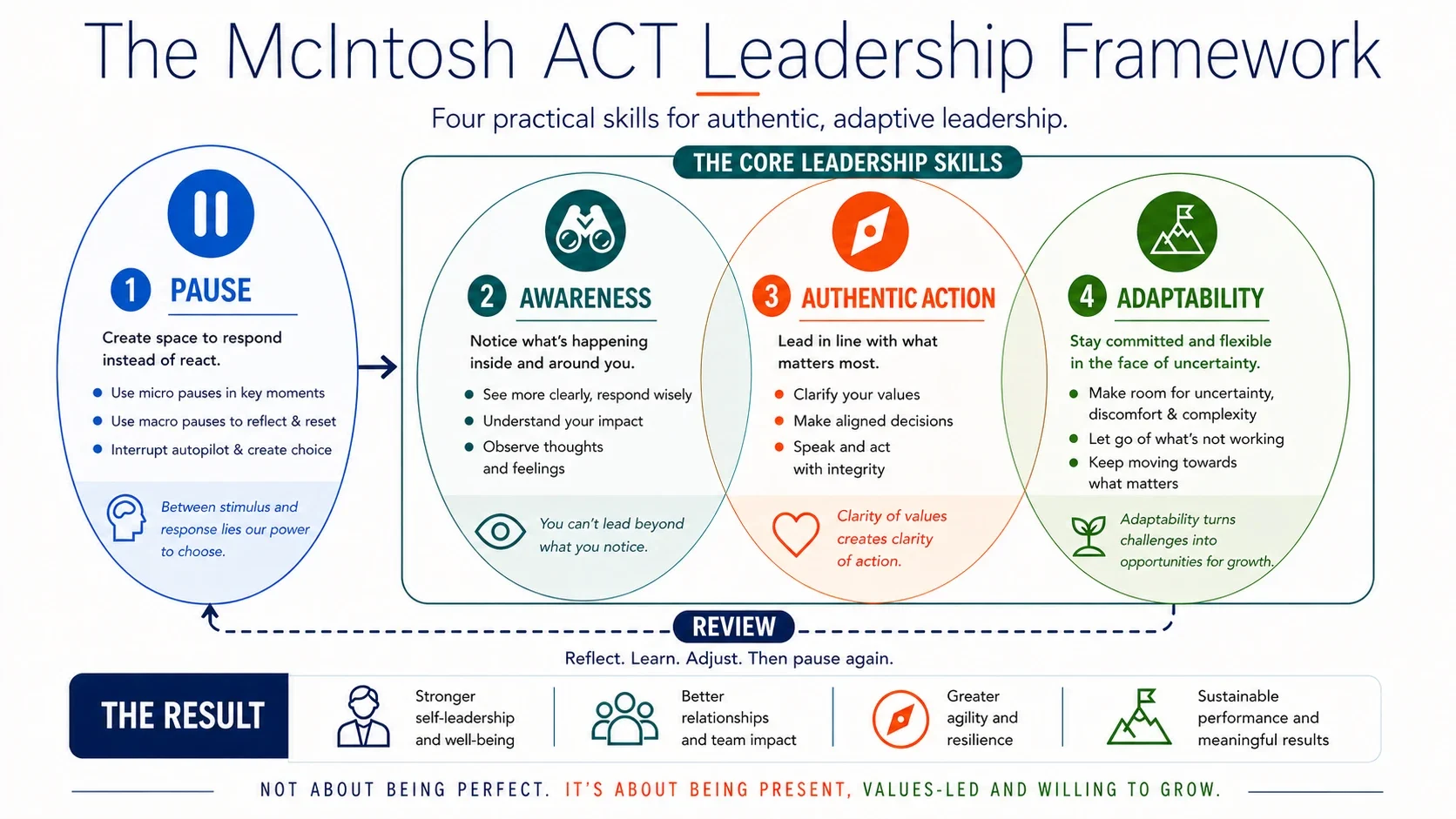
At its core, the framework focuses on four connected leadership skills:
1. Pause
Creating enough space to respond rather than react – interrupting autopilot.
2. Awareness
Noticing thoughts, emotions, patterns, environments and impact more clearly.
3. Authentic Action
Taking action guided by values rather than fear, avoidance or autopilot.
4. Adaptability
Remaining flexible and effective even when circumstances are difficult or uncertain — without being derailed by unhelpful thoughts, emotions or internal stories.
The framework is deliberately practical.
It’s not about becoming a perfect leader.
It’s about developing the ability to stay present, act in line with your values, and remain willing to grow — especially in the moments that matter most.
One thing I’ve learned repeatedly in coaching is this:
Leaders rarely struggle because they don’t care.
They struggle because pressure narrows awareness, pulls them back into habitual responses, and disconnects them from the kind of leader they want to be.
The good news is that these are trainable skills.
And often, meaningful leadership change starts with something surprisingly small: a pause between stimulus and response.
I consider the pause to be a leadership superpower.
I’ll be sharing more about the model, the science behind it, and some practical applications over the coming months.
For now, I’d simply invite you to reflect on this question:
Which of these four leadership skills becomes hardest for you under pressure?